



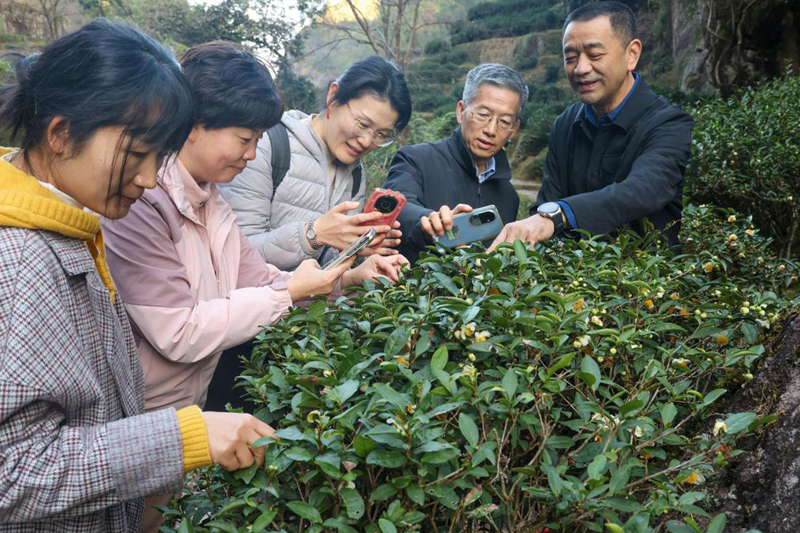
The team examines ancient tea trees at Huiyuan Pit. [Photo provided to chinadaily.com.cn]
A team of tea experts recently conducted a field survey of ancient tea tree resources on Wuyi Mountain in Fujian province, to assess conservation practices. The visit was organized by the National Innovation Alliance for the Protection and Sustainable Utilization of Ancient Tea Trees and involved scholars from Southwest Forestry University and Northwest Agriculture and Forestry University.
During the inspection, the team examined sites such as Huiyuan Pit, focusing on the current state of the protection and use of ancient tea trees.
Wuyi Mountain, a UNESCO World Cultural and Natural Heritage site, is shaped by Danxia landforms that create a distinctive microclimate. Combined with a long history of tea cultivation, these conditions have established the area as a birthplace of oolong and black teas and the historical starting point of the Great Tea Road.
Ancient tea trees, defined in China as camellia plants aged 100 years or more, are regarded as a vital genetic reservoir and a significant part of the nation's botanical and cultural heritage. Ancient wild tea trees in Fujian provide essential genetic resources for ensuring the quality of Wuyi Rock Tea.
The survey also found that the Yunnan Jingmai large-leaf tea plant has been successfully introduced to Wuyi Mountain. Both sides agreed to deepen cooperation in germplasm research, ecological standards, and the transmission of intangible cultural heritage, while emphasizing the need for scientific evaluation and cautious implementation.

Copyright © General Office of Fujian Provincial People's Government
Website Identification Code 3500000049Registration Number: 15003084
All rights reserved. The content (including but not limited to text, photo, multimedia information, etc) published in this site belongs to fujian.gov.cn.
Without written authorization from fujian.gov.cn, such content shall not be republished or used in any form.
