




Podcasters record a program in Dongbi village, Xiapu county, Fujian province. ZHANG XIAOYU/CHINA DAILY
When Indonesian podcaster Rizky Ardi Nugroho arrived in Xiapu county, Fujian province, he expected to find the coastal scenery and distinctive sea erosion landforms that have made the area a favorite destination for photographers.
But during his three-day field trip, Nugroho discovered that Xiapu had much more to offer than picturesque landscapes. He was captivated by its maritime traditions, rich cultural heritage, and vibrant community life.
"If you say Xiapu is a small county, I don't think so," he said. "The urban planning is very good, the county is very clean, and the people are very polite. It was beyond my expectations."
The creator of the Indonesian podcast Do You See What I See was among a group of domestic and international podcasters invited to a Xiapu field trip as part of the Second Gen Z International Podcast Festival from June 10 to 12. Nugroho's experience was exactly the kind of encounter the event hoped to create.
Themed "Xiapu: Where Mountains Meet the Sea", the festival aimed to encourage multilingual content creation through field visits and cultural exchanges, bringing together podcasters, communication professionals, and young creators.
For nearly eight years, Nugroho has built a following through stories that bridge China and Indonesia, exploring culture, folklore, and local traditions for Indonesian audiences.
During the trip, he was drawn not only to the county's natural views, but also to its efforts to preserve traditional culture, including wedding ceremonies, bamboo pole dances, martial arts performances, and historical artifacts.
One of his most memorable discoveries was the connection he saw between Xiapu and his homeland.
"As an archipelagic nation, Indonesia shares a long maritime tradition with China's southeastern coast. We share similar conditions in agriculture," he said.
Nugroho's discoveries, experts say, reflect a broader shift in international communication — from abstract national narratives to concrete local experiences.
"When storytelling reaches counties and smaller communities with distinctive local characteristics, it becomes more vivid and helps present a more comprehensive, authentic, and multidimensional picture of China," said Zhang Yanqiu, deputy dean of the Institute for a Community with Shared Future at the Communication University of China.
She said podcasts are particularly suited to this kind of storytelling because they allow for sustained discussion and more focused exploration.
"If people want a deeper understanding of a topic, short videos are often not enough," she said. "Podcasts provide a more immersive experience and enable more precise communication."
This search for depth shaped the way many creators explored Xiapu.
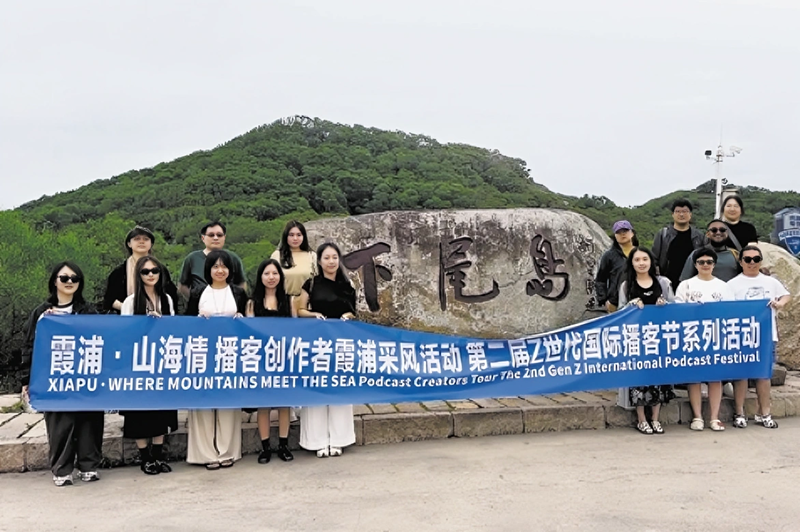
Podcast creators pose for a group photo on Xiawei Island in Xiapu county, Fujian province. CHINA DAILY
Finding deeper voices
Yang Guowei, creator of the travel podcast Grand Traveler: Humanistic Travel Audio Journal, has long documented destinations through history, geography, and local culture.
In Xiapu, he spoke with a local seaweed farmer to better understand one of the county's pillar industries.
From the farmer, Yang learned that seaweed production runs from seedling cultivation in autumn to harvesting in spring. In the past, without machinery, workers had to rely entirely on manual labor to harvest seaweed from the ocean. The seaweed fields, arranged like rows of crops, required immense physical effort to harvest.
Although modern machinery has eased part of the burden, tasks such as drying the seaweed still require significant manual labor.
"After learning about the process, I realized how much effort goes into something we often take for granted," Yang said. "When people travel after listening to my podcast, I hope the landscapes they see come with 'subtitles'. There are stories behind them."
If Yang found hidden labor behind Xiapu's seascapes, other podcasters found emotional ties behind its cultural traditions.
Podcast hosts Zhang Erda and Shanshan (both pseudonyms) are known for discussing the thoughts and emotions of young urbanites on their podcast Bye-Bye-Work.
During their visit to Banyueli, an ancient village of the She ethnic group in Xiapu, they began reflecting on why some people remain so deeply connected to their places of origin.
One person who left a lasting impression was Lei Qisong, a local cultural inheritor and founder of a museum dedicated to preserving She culture.
Lei has invested his own money in the museum, collecting artifacts ranging from wood carvings and traditional costumes to furniture and objects used in She ethnic wedding customs. Together with his family, he has devoted himself to preserving and passing on local culture.
"People here genuinely love where they live. They identify with their culture, appreciate it, and believe it is worth sharing with others. That kind of confidence is very contagious," Zhang Erda said.
That emotional and spiritual resonance is something Zhang Erda and Shanshan hope to convey to their listeners.
To them, the spirit of a place can be infectious, and it is this intangible quality that they want to capture through their podcast.
"They remind us of who we truly are," Zhang Erda said. "In cities, we often maintain boundaries and keep our distance, but in places like this, people are more open and eager to share their passions. This openness fosters genuine connections."
Making stories travel
For Zhang Erda and Shanshan, the trip is likely to become part of a future podcast episode.
Rather than simply recounting what they saw in Xiapu, they hope to use the journey as a starting point for broader discussions about travel, identity, and the ways people connect with places.
"We usually focus on the thoughts and emotions of young people living in cities," Zhang Erda said. "A trip like this gives us an opportunity to connect personal experiences to larger themes that more people can relate to."
For Shanshan, podcasting is also rewarding for the host.
"Long conversations force you to be more honest. After talking for an hour, you can't really hide behind a version of yourself. You begin to understand yourself better, and listeners have time to think alongside you," she said.
According to Zhang Yanqiu, podcasts and other forms of "soft communication" can help local stories reach wider audiences. But turning those stories into effective international communication still requires precision, focus, and continued exploration.
She said broader national narratives are ultimately built through specific, lived experiences rather than abstract concepts.
"When you travel and see different places, you begin to understand China in a more concrete way," she said.

Copyright © General Office of Fujian Provincial People's Government
Website Identification Code 3500000049Registration Number: 15003084
All rights reserved. The content (including but not limited to text, photo, multimedia information, etc) published in this site belongs to fujian.gov.cn.
Without written authorization from fujian.gov.cn, such content shall not be republished or used in any form.
